
Medicine
Medicine at a Crossroads, Part One
Free
Bernard's first crossroads came close to forty, when he decided to practise medicine without drugs. He traces what that taught him, and what the editors of leading medical journals now say about the state of medical science.
Crossroads are interesting places. Choices have to be made and it’s not easy to return back.
Just think about what happened with Covid and the crossroads come thundering into view. The majority of people were convinced that the vaccine would save lives and not cause any problems, while a much smaller group were very much on the other side, warning against taking the vaccine, especially before it was properly tested.
And this polarity was equally strong amongst professionals.
Think about Artificial Intelligence and again the crossroads show up. Speak to children today and recognize your inability to even understand their language.
I personally reached my first crossroads in medicine when I was close to 40 years old and decided to see whether it was possible to practice medicine without drugs. That was a huge decision for a qualified medical doctor, long before Integrative medicine was even heard of. All I had in my doctor’s bag at the time was Brewer’s yeast and kelp, plus a cleansing diet given to me by a naturopath.
When people started to get better with these simple remedies, something really shifted in my understanding. How was it possible that ill-health would disappear without drugs? These simple remedies were clearly not powerful enough to interfere with a physiological function and treat the symptoms. Something else was going on. It took me a while to realize that what the diet plus the vitamin Bs in the Brewer’s yeast, plus the minerals in kelp, were doing was actually supporting a healthy function and that better health was doing the healing.
That insight was a real aha! moment. I did not need to block a function to reduce the symptoms but just improve health and allow the health to do the healing that it was really good at.
That approach in time became what is now called Integrative Medicine. Integrative Medicine incorporated all that I knew from my training as a conventional medical doctor, and it worked to make a diagnosis, treat with drugs and surgery if needed, and combine this approach using natural preparations and nutritional supplements, herbs, vitamins and minerals and a range of other physical approaches to support health. Supporting health became my priority, and to my surprise the need for drugs and even surgery fell dramatically.
I can remember as a child when medical doctors still did house calls. They learnt about the family’s dynamics and generally had a very special place within the family space.
Today the practice of medicine has become very much more impersonal. Medical aids tend to prescribe to doctors what they can use to treat clients; specialist committees develop protocols for treating conditions which must be followed to avoid litigations. Medical Associations also have requirements for doctors to follow (some good, like ethical considerations), and then there is the enormous pressure and incentives from pharmaceutical companies to use their drugs. Private hospital management also has a say, requiring doctors to fill the beds if they want to use that space. With all the money involved and required for medical research, medical schools have to toe the line with the pharmaceutical companies, trying their best to get results that will work for the sponsorship to keep flowing in.
Medicine today has become a business, with the profit motive high on the agenda and all the resultant restrictions and pressures. Nothing wrong with this, I guess, everyone needs to make a living, but it does mean that like all businesses there is the possibility of a dark side developing, when money and pride dominate the narrative around the way medicine is practised.
This is what some editors of medical journals have to say about what has happened to medical science today:
“It is simply no longer possible to believe much of the clinical research that is published, or to rely on the judgement of trusted physicians or authoritative medical guidelines. I take no pleasure in this conclusion, which I reached slowly and reluctantly over my two decades as editor of the New England Journal of Medicine.” (Marcia Angell, 2009)
That is quite frightening when it comes from someone who knows what is happening, but she is not the only one:
“The case against science is straightforward: much of the scientific literature, perhaps half, may simply be untrue. Afflicted by studies with small sample sizes, tiny effects, invalid exploratory analyses, and flagrant conflicts of interest, together with an obsession for pursuing fashionable trends of dubious importance, science has taken a turn towards darkness,” wrote Richard Horton, editor of the Lancet in 2015. This statement from an editor of one of the most prestigious medical journals is astonishing, and should have been deeply discussed in all medical circles. Sadly, this has not happened, and in fact the situation may have become even worse. Richard Smith, editor of the British Medical journal (quoting statistician Douglas Altman): “The poor quality of medical research is widely acknowledged yet disturbingly the leaders of the medical profession seem only minimally concerned about the problems and make no apparent effort to find a solution.” (2014).
The problem is that this bad science is driving medical programmes, allowing drugs on the market which are not safe, don’t work for the indications required and costing money that could be spent in better ways. Wrong information, once it is out there, takes many years to shift and Iatrogenic disease (doctor induced ill-health) has become the third most common cause of ill-health and death.
Part of the problem is that medicine cannot ever be an exact science. Unlike machines, living systems are not made of parts that can be taken apart and re-assembled. Human beings are not machines, and while this seemed like a good model in the early days with the astonishing development of surgery and surgical techniques, this will not work for complex multidimensional systems like humans who are matter-energy-information-quantum systems, and body-emotions-mind-spirit-consciousness . The machine model cannot meet the expectation of such a complex system. The system is creative and intelligent and requires co-operation and not control.
Quantum science has cracked the shell and is pointing to the complexity of systems. The following statements from scientists are illuminating.
“The Universe is probably not just queerer than we suppose, but queerer than we can suppose,” wrote scientist JBS Haldane (1927) in Possible Worlds.
“Science tells us what we can know, but what we can know is little, and if we forget how much we cannot know we become insensitive to many things of great importance,” wrote philosopher Bertrand Russell in 1945.
And Danish physicist and Nobel Prize winner for Physics, Niels Bohr: “Everything we call real is made of things that cannot be regarded as real.”
Werner Heisenberg, another Nobel Prize winner for Physics said: “The atom has no physical properties at all.”
Theoretical physicist Amit Goswami: “We cannot make sense of quantum physics unless we ground it in the primacy of consciousness.”
Max Planck, originator of Quantum Theory: “I regard consciousness as fundamental. I regard matter as derivative from consciousness.”
Physicist David Bohm: “The cosmos is a single, unbroken wholeness in flowing movement.” And philosopher Ludwig Wittgenstein: “…that even when all possible scientific questions have been answered, the problems of life still remain completely untouched.”
These quotations from leading scientists point to complexity on one hand, and the impossibility of ever having perfect answers.
Deep humility is called for here.
So what exactly is the fork in the road?
(Part 2 to follow)
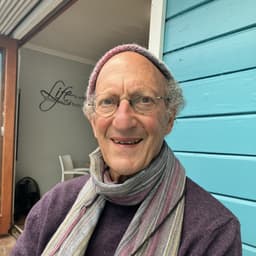
Dr Bernard Brom
Founder, Creating Health
Bernard Brom qualified in medicine in 1965. He gave it up, travelled for six years, and came back to spend the next sixty asking one question: how does health actually work? He founded the South African Society of Integrative Medicine, chaired it, started its first journal, wrote two books — and still sees a few patients every week, "to stay in touch with the territory."
Continue exploring