
Medicine
Medicine at a Crossroads, Part Two
Free
Bernard explains what he calls Newtonian, or flat earth, medicine: why reducing people to what can be measured leaves so much out, and what quantum science suggests living systems are instead.
As indicated in part 1, the one direction medicine has taken is what I call Newtonian medicine or even flat earth medicine. What I mean by that is that medical science, in order to try find a logical science-based answer to the complexity of living systems, has reduced human beings to that which can be measured. And then based the whole of modern medicine on this very narrow window.
If you only measure the top of an iceberg sticking out of the water, there is no way to know the shape of the whole iceberg. This approach is called reductionism and refers to the way of reducing complexity to simple, scaled-down working models.
What this means for human beings and the understanding of health and ill health is that human beings are reduced to objective criteria which can be measured, leaving out subjective aspects that are the living experience of humans.
The causes of ill-health are also reduced to that which seems obvious, and again leaves out the difficult elements like electromagnetism, information, cosmic influences, mind and consciousness. The constructed map of human function is reduced to biochemistry and while today this is very sophisticated, it nevertheless is an idealized understanding of function, based on reducing physiology to parts and structures and a range of sophisticated assumptions based on this measurement. It is mapping but may not be anything like the way the human systems actually function. The territory is not the map, and the map is not the territory. Maps are very useful, but it is still important to recognize the limitations and the illusory nature of maps.
Fortunately, quantum science has shown the limitations of the Newtonian approach to living systems. Quantum understanding has introduced scientists to the nature of complexity, coherence, non-linear dynamics, the influence of the observer, and that matter is energy-information at its base or ground state.
Perhaps the most important aspect of the crossroads is that living systems are not machines which can be taken apart in order to understand how they function, but a very, very complex system in flow.
Taking a system apart leaves one with bits and pieces, and no system. The system must be examined in its full capacity and function in order to understand its nature. Each system is unique in the way it opens to the outer world, and the way it is in touch with an inner world that is a mystery still to be understood.
According to quantum science there is no matter as such, only vibrating energy. When matter was finally broken down to its basic building blocks there was nothing solid. Particles are just vibrating infinite fields of energy, interacting with other vibrating fields. Human beings only appear to have a solid body, and that is an illusion. Not that there is no body, but the body is not what it appears to be. We are much closer to a musical instrument that needs constant tuning to be coherent to source. This is a new concept of health and ill health. The old concept was based on the machine model made of solid parts.
This is the crossroad.
It does not mean an absolute negation of all that we have developed up to now. The new pathway does not exclude the past but recognizes its limitations. Unfortunately we have developed an industry that depends on this machine model for its financial gains and this is so massive that the shift will not be an easy one, unless miraculous events happen to show the inadequacy of this model.
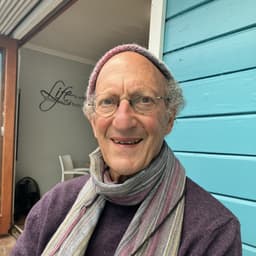
Dr Bernard Brom
Founder, Creating Health
Bernard Brom qualified in medicine in 1965. He gave it up, travelled for six years, and came back to spend the next sixty asking one question: how does health actually work? He founded the South African Society of Integrative Medicine, chaired it, started its first journal, wrote two books — and still sees a few patients every week, "to stay in touch with the territory."
Continue exploring